
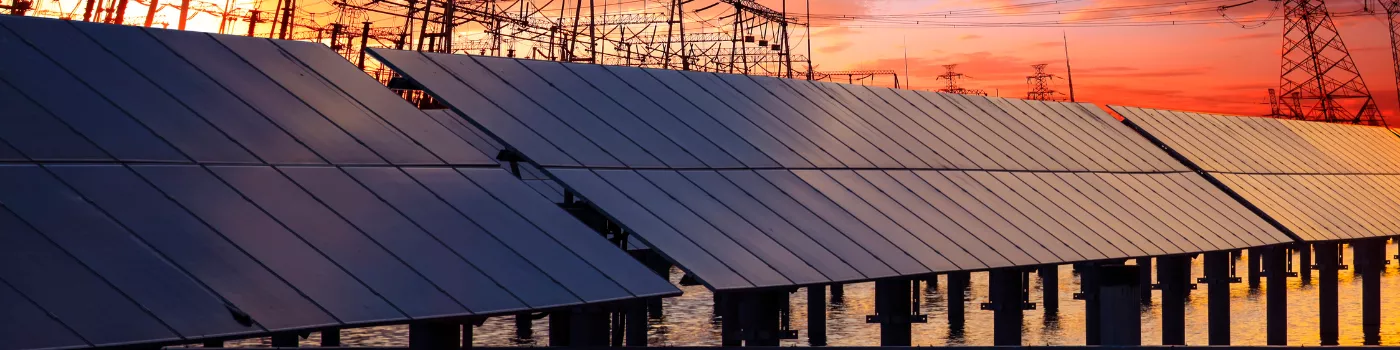
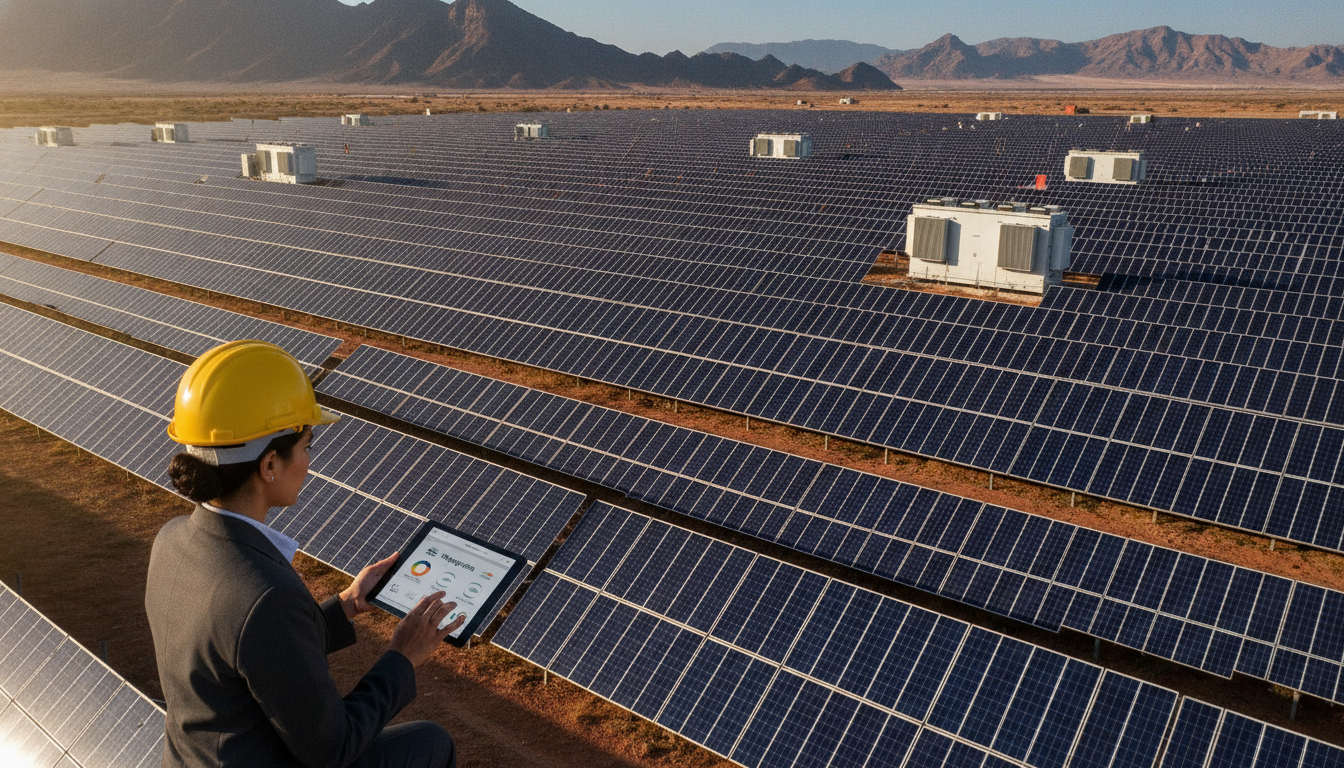
India is currently undergoing a massive transformation in its energy landscape as it approaches 2026. The nation is prioritising clean power to meet ambitious decarbonisation targets and ensure long-term energy security.
At the heart of this transition are utility scale solar projects. These massive installations serve as the primary engine for the country’s shift away from fossil fuels.
By harnessing vast tracts of land, these utility solar power plants provide the consistent electricity needed to fuel industrial growth. They are now recognised as the essential backbone of the national grid.
Understanding how these systems function is vital for stakeholders and investors alike. This guide explores the technical and economic factors driving this green revolution across the subcontinent.
Key Takeaways
- India is rapidly accelerating its transition towards renewable energy sources to meet 2026 climate goals.
- Large-scale projects are central to the national strategy for achieving carbon neutrality.
- These installations provide the reliable capacity required to support a growing industrial economy.
- Investment in modern infrastructure is essential for maintaining grid stability and efficiency.
- The sector offers significant opportunities for stakeholders involved in sustainable development.
Current Landscape of Utility Scale Solar in India
The landscape of renewable energy in India is shifting dramatically as utility scale solar becomes a cornerstone of the national power strategy. This transition is supported by a robust policy framework that encourages massive investment in clean energy infrastructure across the country.
As the nation strives to meet its ambitious climate targets, the focus has moved toward creating sustainable and scalable energy solutions. This shift is not merely environmental but also a strategic move to ensure long-term energy security for a growing economy.
Growth Trajectory of Grid-Connected Solar Farms
The rapid expansion of grid-connected solar farms has been nothing short of remarkable over the past few years. This growth is primarily fuelled by proactive government initiatives, such as the development of solar parks and competitive bidding processes that attract global investors.
Private sector participation has reached an all-time high, bringing in advanced technology and operational efficiency. Solar farm development is now a highly competitive sector, with developers constantly seeking ways to optimise output and reduce costs.
These large-scale projects are essential for stabilising the national grid while providing affordable power to millions. The consistent increase in installed capacity demonstrates the confidence that both domestic and international stakeholders have in the Indian market.
Key Regions Driving Solar Electricity Generation
Certain states have emerged as clear leaders in solar electricity generation due to their favourable geographical conditions and supportive local policies. Rajasthan and Gujarat currently stand at the forefront of this movement, hosting some of the largest solar installations in the world.
Rajasthan benefits from vast stretches of arid land and high solar irradiance, making it an ideal location for solar farm development. Meanwhile, Gujarat has successfully integrated its industrial growth with renewable energy adoption, creating a model for other states to follow.
These regions are not only contributing significantly to the national grid but are also fostering local economic growth. By prioritising utility scale solar, these states are setting a benchmark for efficient solar electricity generation that others are now eager to replicate.
Technical Design and Infrastructure Requirements
Technical excellence serves as the foundation for every successful solar farm development in the modern Indian market. Engineers must balance environmental constraints with the need for high-efficiency energy production. This process requires a deep understanding of local topography and grid connectivity standards.
Site Selection and Land Acquisition Strategies
Selecting the right location is the most critical step in project planning. Developers must evaluate solar irradiance levels, soil stability, and proximity to existing transmission infrastructure. In a densely populated country like India, securing large, contiguous land parcels often involves complex negotiations with multiple stakeholders.
Strategic land acquisition requires a thorough assessment of legal titles and land-use classifications. Developers often prefer barren or semi-arid land to avoid conflicts with agricultural interests. This approach ensures faster project clearance and long-term operational stability.
Solar Panel Array Installations and Mounting Systems
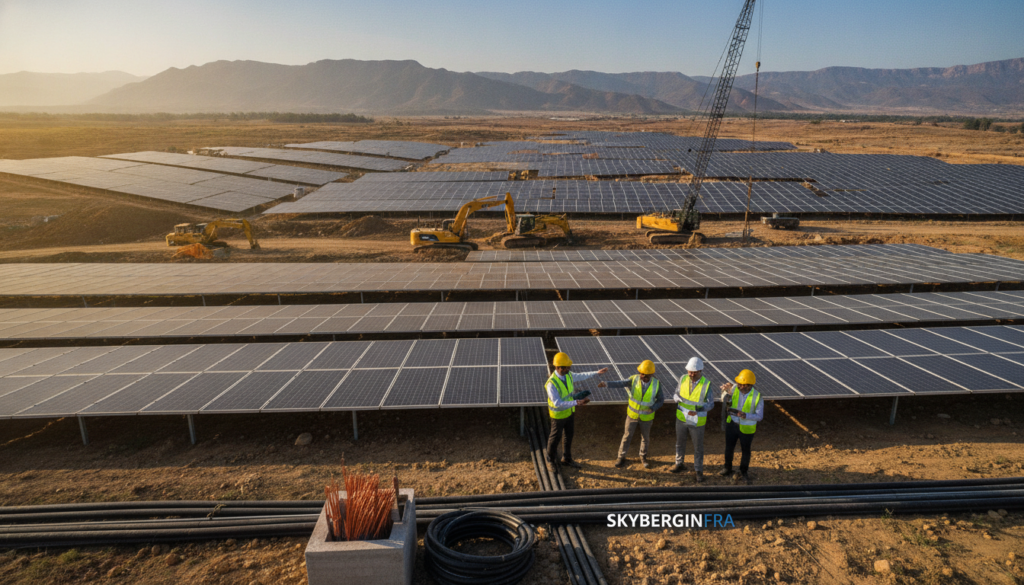
The efficiency of a project depends heavily on the quality of solar panel array installations. Mounting systems must be designed to withstand local wind speeds and extreme weather conditions. Engineers typically choose between ground-mounted structures that provide the best balance of durability and cost-effectiveness.
Fixed-Tilt Versus Single-Axis Tracking Systems
Choosing the right mounting technology significantly impacts the total energy yield of the plant. While fixed-tilt systems offer simplicity and lower maintenance, tracking systems provide superior performance by following the sun’s path throughout the day.
| Feature | Fixed-Tilt System | Single-Axis Tracker |
|---|---|---|
| Energy Yield | Baseline | 15-25% Higher |
| Capital Cost | Lower | Higher |
| Maintenance | Minimal | Moderate |
| Land Usage | High Density | Requires Spacing |
Power Evacuation and Substation Integration
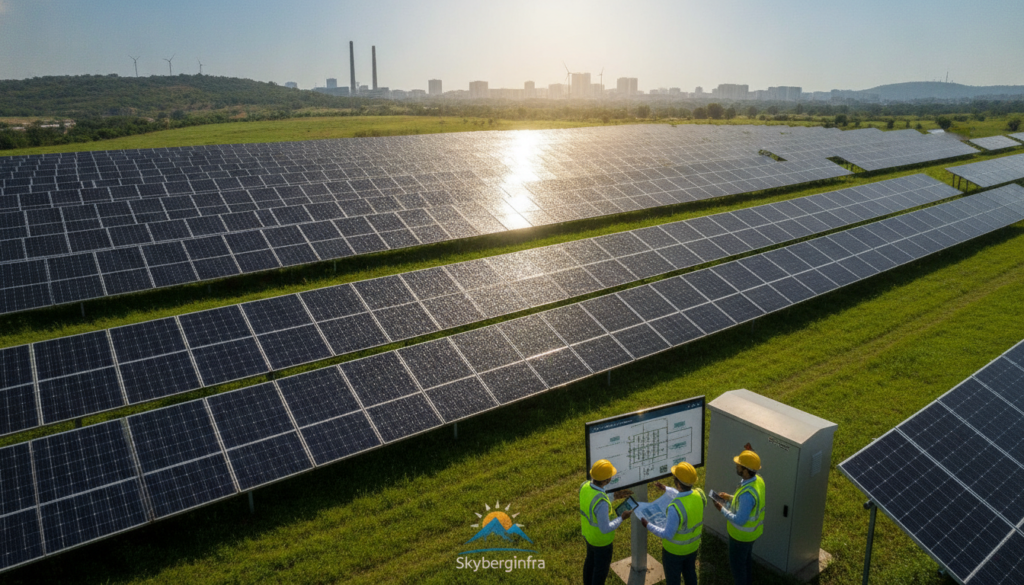
Once the energy is captured, it must be efficiently transmitted to the national grid. This requires the construction of dedicated substations and high-voltage transmission lines. Proper integration ensures that the power generated by solar panel array installations reaches the grid with minimal losses.
Engineers must coordinate closely with state transmission utilities to ensure compliance with grid codes. Reliable power evacuation is essential for maintaining the financial viability of any large-scale solar farm development. Robust substation design remains the final hurdle in delivering clean energy to the Indian population.
Regulatory Framework and Government Incentives
Government policies act as the backbone for the rapid expansion of renewable energy infrastructure across the nation. Investors and developers must navigate a sophisticated legal environment to ensure long-term project viability. A clear understanding of these rules is vital for mitigating risks in the Indian market.
Policy Support for Renewable Energy Infrastructure
The Ministry of New and Renewable Energy (MNRE) provides the primary guidance for the sector. Various schemes, such as the Solar Park Scheme, offer developers access to pre-cleared land and shared transmission infrastructure. These initiatives significantly reduce the initial burden on companies building utility solar power plants.
State-level policies further complement central efforts by offering specific incentives. Many states provide exemptions on electricity duty and cross-subsidy surcharges for captive solar projects. Strategic alignment with these regional policies often determines the financial success of a solar farm.
Understanding Power Purchase Agreements (PPAs)
A Power Purchase Agreement (PPA) serves as the cornerstone of revenue security for developers. This legal contract defines the tariff at which electricity is sold to the distribution company (DISCOM) over a long period, typically 25 years. Securing a bankable PPA is essential for attracting institutional investment.
Modern PPAs often include clauses for payment security, such as letters of credit or escrow accounts. These mechanisms protect developers against potential payment delays from state utilities. Careful negotiation of these terms ensures that cash flows remain predictable throughout the project lifecycle.
Compliance and Environmental Clearances
Operational success requires strict adherence to environmental and land-use regulations. Developers must obtain clearances from state pollution control boards and ensure compliance with the Forest Conservation Act where applicable. Failure to secure these permits early can lead to significant project delays.
Grid connectivity is another critical area of compliance. Projects must meet the technical standards set by the Central Electricity Authority (CEA) to ensure safe integration into the national grid. Maintaining robust compliance standards protects the long-term interests of stakeholders and ensures the project remains legally sound.
Economic Viability and Investment Trends
Investors are increasingly prioritising the long-term profitability of utility-scale solar assets across the country. As India accelerates its transition to renewable energy, the financial structures supporting these projects have become more sophisticated and resilient.
Capital Expenditure and Operational Cost Analysis
The initial investment for solar panel array installations remains the most significant hurdle for developers. However, economies of scale and advancements in manufacturing have steadily reduced these costs over the last decade.
Operational expenditure, or OPEX, is equally critical for maintaining high levels of solar electricity generation. Regular cleaning, inverter maintenance, and grid monitoring are essential to ensure that the plant operates at peak efficiency throughout its lifecycle.
“The shift towards sustainable energy is no longer just an environmental imperative; it is a sound financial strategy that offers predictable, long-term returns for institutional investors.”
Financing Models for Commercial Solar Installations
Diverse financing models are currently enabling the rapid growth of commercial solar installations in the Indian market. Developers often utilise a mix of debt and equity to balance risk and reward effectively.
Green bonds and sustainability-linked loans have emerged as popular instruments for funding large-scale projects. These financial tools provide lower interest rates, which significantly improves the overall internal rate of return for project sponsors.
Return on Investment Projections for 2026
Looking ahead to 2026, the outlook for solar electricity generation remains highly positive. Despite fluctuations in global equipment prices, the falling cost of capital and supportive government policies are expected to bolster investor confidence.
The following table outlines the projected financial performance metrics for utility-scale projects in the coming year:
| Metric | Estimated Value (2026) | Impact on ROI |
|---|---|---|
| Average CAPEX per MW | ₹4.2 – ₹4.5 Crores | High |
| Annual OPEX per MW | ₹0.15 – ₹0.20 Lakhs | Moderate |
| Expected IRR | 12% – 15% | High |
| Payback Period | 6 – 8 Years | Moderate |
By focusing on commercial solar installations and optimising solar panel array installations, developers can secure stable cash flows. These projections suggest that the sector will continue to attract significant domestic and international capital.
Challenges in Large Scale Solar Energy Projects
While the growth of renewable energy is impressive, large scale solar energy projects face significant obstacles that require careful navigation. Developers must balance rapid deployment with the realities of infrastructure limitations and local socio-economic factors. Addressing these hurdles is essential for maintaining the momentum of India’s energy transition.
Grid Stability and Intermittency Management
The inherent variability of sunlight poses a major challenge for grid-connected solar farms. As solar penetration increases, maintaining a stable frequency becomes more difficult for grid operators. Sudden drops in generation due to cloud cover can lead to significant imbalances in the power network.
To manage this, developers are increasingly looking at advanced forecasting tools and hybrid plant designs. Integrating energy storage solutions helps smooth out the power output, ensuring that the electricity supplied to the grid remains consistent. Without these measures, the reliability of the national power system could be compromised.
Supply Chain Constraints and Component Sourcing
Global supply chain disruptions often impact the timely delivery of critical hardware for utility scale solar installations. Dependence on imported photovoltaic modules and high-efficiency inverters creates vulnerability to international market fluctuations. These delays can lead to increased project costs and missed commissioning deadlines.
Many firms are now diversifying their procurement strategies to mitigate these risks. By fostering domestic manufacturing capabilities, the industry aims to reduce its reliance on external suppliers. This shift is vital for the long-term resilience of the sector.
Land Use Conflicts and Community Engagement
Securing vast tracts of land for utility scale solar often leads to friction with local communities and agricultural interests. Proactive engagement is necessary to ensure that land acquisition processes are transparent and fair. Developers who prioritise sustainable development practices often find it easier to gain local support.
Effective strategies include co-locating solar arrays with agricultural activities, a practice known as agrivoltaics. This approach allows land to serve dual purposes, benefiting both the energy sector and local farmers. Building trust through open communication remains the most effective way to resolve potential disputes.
| Challenge Category | Primary Impact | Mitigation Strategy |
|---|---|---|
| Grid Stability | Frequency fluctuations | Hybrid storage integration |
| Supply Chain | Project delays | Localised procurement |
| Land Use | Community opposition | Agrivoltaic implementation |
Technological Innovations Shaping 2026 and Beyond
Modern engineering is pushing the boundaries of what is possible for large scale solar energy projects across India. As the nation accelerates its transition to green energy, the adoption of sophisticated hardware and software becomes essential. These advancements ensure that solar farms remain productive and cost-effective over their entire operational lifespan.
Advancements in Bifacial Module Efficiency
Bifacial solar modules have emerged as a game-changer for utility-scale developments. Unlike traditional panels, these modules capture sunlight on both sides, significantly increasing the total energy yield per square metre. This dual-sided absorption is particularly effective in regions with high albedo, such as sandy or light-coloured terrains common in parts of Rajasthan and Gujarat.
By utilising reflected light from the ground, developers can achieve a higher return on investment. The industry is now seeing a shift towards larger, more durable bifacial cells that withstand harsh environmental conditions. This evolution is critical for maintaining high performance in the intense heat of the Indian climate.
Artificial Intelligence in Plant Monitoring and Maintenance
The integration of Artificial Intelligence (AI) is transforming how operators manage complex solar assets. AI-driven platforms provide real-time data analytics, allowing for the early detection of faults in inverters or tracking systems. Predictive maintenance schedules are now replacing reactive repairs, which helps in reducing downtime significantly.
Machine learning algorithms can predict energy output based on weather patterns and historical performance data. This level of precision allows site managers to optimise cleaning cycles for panels, ensuring that dust accumulation does not hinder efficiency. Consequently, the overall reliability of the power plant is greatly enhanced.
Energy Storage Integration for Utility Scale Solar
Energy storage systems are becoming the backbone of modern commercial solar installations. As solar power is inherently intermittent, large-scale battery storage helps balance the grid by releasing stored energy during peak demand hours. This capability is vital for ensuring a stable and consistent power supply to the national grid.
The following table outlines the performance improvements brought by these modern technological shifts:
| Technology Feature | Traditional Systems | Modern 2026 Systems |
|---|---|---|
| Module Type | Monofacial | High-Efficiency Bifacial |
| Maintenance | Reactive/Manual | AI-Driven Predictive |
| Grid Reliability | Low (Intermittent) | High (Storage Integrated) |
| Operational Cost | Standard | Optimised/Reduced |
Investing in these technologies is no longer optional for developers aiming for long-term success. By combining bifacial modules, AI monitoring, and robust storage, stakeholders can ensure that their large scale solar energy projects remain competitive. These innovations are the key to securing a sustainable energy future for India.
Conclusion
India stands at a pivotal moment in its transition to clean power. The rapid evolution of the solar sector marks a new era for the nation as it moves towards 2026. Success depends on the collective effort of policymakers, private investors, and local communities to build a resilient grid.
Investment in robust renewable energy infrastructure remains the primary driver for long-term success. Stakeholders must prioritise efficiency and innovation to navigate the complexities of this expanding market. By focusing on smart grid integration and advanced storage solutions, the country can overcome existing barriers to growth.
The path forward requires a commitment to quality and sustainable practices. Continued support for high-capacity renewable energy infrastructure will ensure that India meets its ambitious climate goals. Industry leaders should stay informed about emerging trends to maintain a competitive edge in this dynamic environment. Your active participation in this transition helps shape a cleaner and more prosperous future for all citizens.